
3. How do I use the CHAT?
This section will explain the CHAT in more detail:
- The 3 traffic light colours.
- The 6 assessment areas.
The following questions will be answered:
- What is in the GREEN?
- What is in the AMBER?
- What is in the RED?
The following explanation is the first part of your learning.
Your cardiac nurse will discuss the CHAT with you. You will have the opportunity to:
- Find out more.
- Ask questions.
- Practice using the CHAT with help from the nurses.
As you start to use the CHAT it will become a normal part of caring for your baby.
Some parents have said that the more they used the CHAT, the more comfortable they felt. They found they were naturally remembering the information in the CHAT and it became easier to notice any changes in their baby.
Here is what two parents have said:

“I feel good, because I’m with my baby everyday, have been looking at the CHAT everyday whilst in hospital, I know when my baby is poorly, I know when he’s in green, when he’s in amber and when to call 999”
” we did used the CHAT when we first came out because we were nervous and we needed it to help us…… now we feel confident enough that we know the signs to check for and the traffic light system ourselves and kind of know where it would be in the book“
The 6 assessment areas
Each section (GREEN, AMBER and RED) contains important information. This will help you decide whether your baby is doing well or needs help.
You will need to assess your baby’s:
| Behaviour | Skin Colour Warmth | Breathing | Oxygen Saturation | Feeding Nappies | Parent Response |
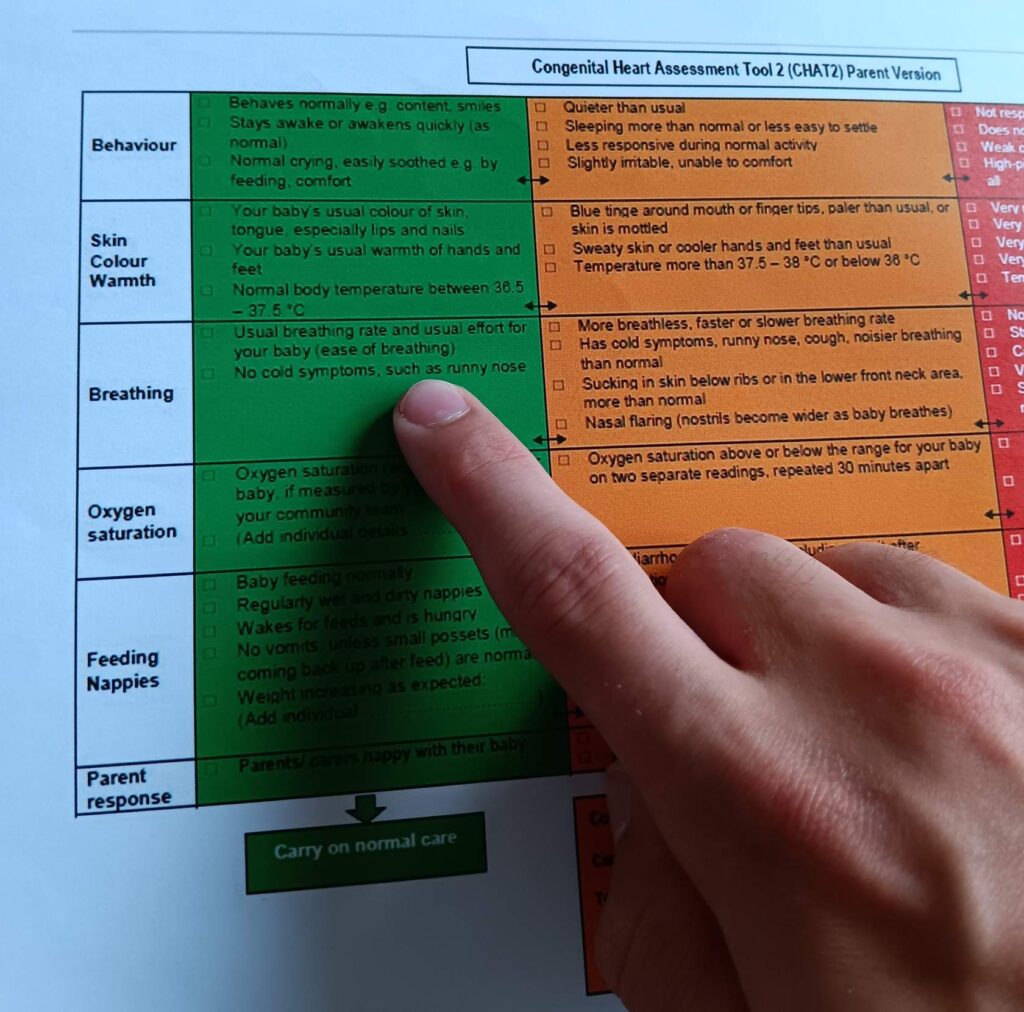
What is in GREEN?
The information in the GREEN section is shown below.
- If you decide your baby meets all of the descriptions in the GREEN section, this is good.
- You can continue as normal and enjoy your baby.
You are happy.

IMPORTANT: After you have looked at each of the 6 areas in the GREEN section you will also need to look at the same areas in the AMBER section.
Compare the descriptions in GREEN with the descriptions in AMBER.
You must make sure there are no concerns.
For example:



“…you look at her and you go through all of them CHATs and you go right ok yes, if I have any worries I go to amber and then you can ring somebody up to talk to somebody”
Parent experience of using the CHAT
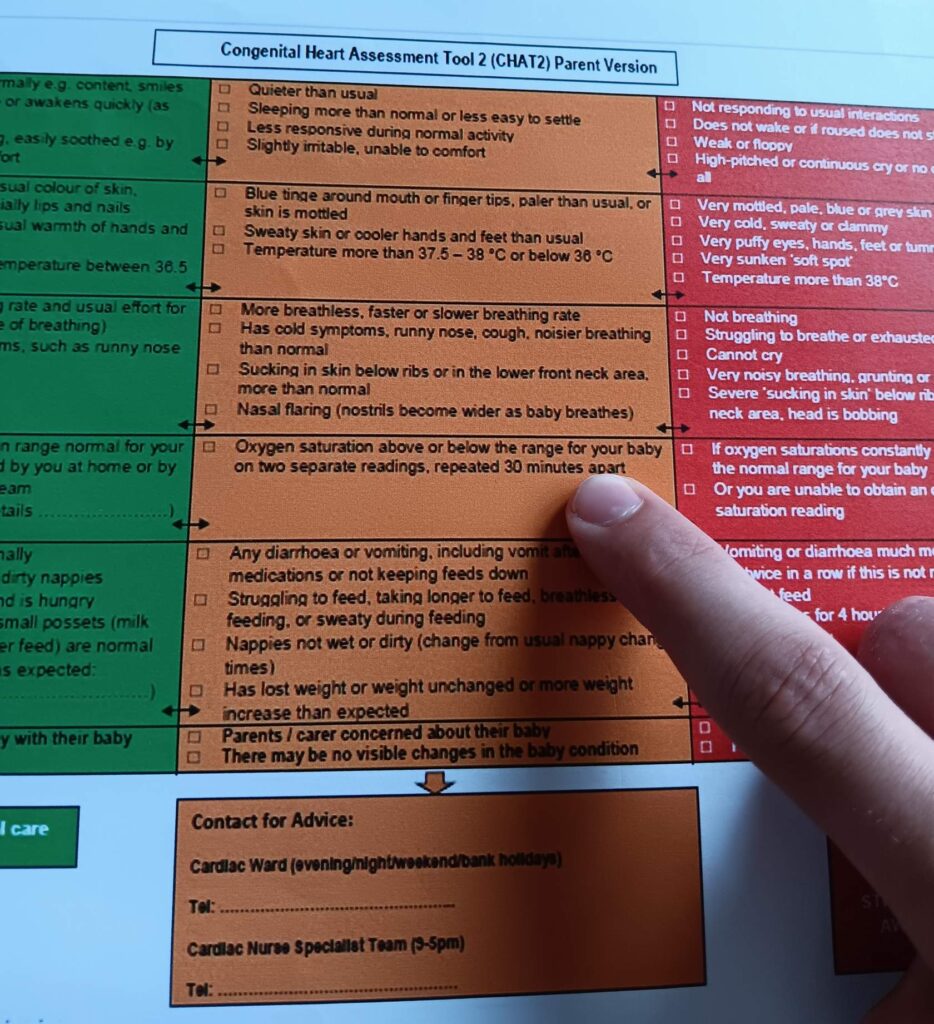
What is in AMBER?
The information in the AMBER section is shown below.
- If you decide your baby is showing something in the AMBER section then this is a concern.
- You might decide there is a change in only one thing. This is still a concern.
You are concerned.

IMPORTANT: After you have looked at each of the 6 areas in the AMBER section you will also need to look at the same areas in the RED section.
Compare the descriptions in AMBER with the descriptions in RED.
Make sure emergency care is not needed.
For example:

If your baby shows changes as described in the AMBER section you will need to get help from a cardiac healthcare professional.
You must make a telephone call to get advice.
It could be only one thing. For example, it is only ‘Sweaty skin or cooler hands and feet than usual in nappy’.
Parents have found the CHAT to be really helped:

“It’s really helpful because it tells you what to look for in green, amber and red. If I didn’t have the CHAT to look at when my was poorly the other night, I would have gone running straight into hospital; I wouldn’t have known what to tell the doctor when I phoned up. The CHAT triggered Amber. It’s really helpful. It’s helping me to describe what I’m seeing.”
“Reading through the coloured chart helped me to decide whether to get help or not, so I did find it useful from that point of view. There were just a couple of times that I phoned through. Having that to refer to just to double check things, it did help. The CHAT was easy enough to use, I wouldn’t say there was anything to change. It seemed to work“
What if I am not sure?
If you are not sure the change you are seeing is definitely in the AMBER section and feel it might be in the RED section, you will need to get emergency help.
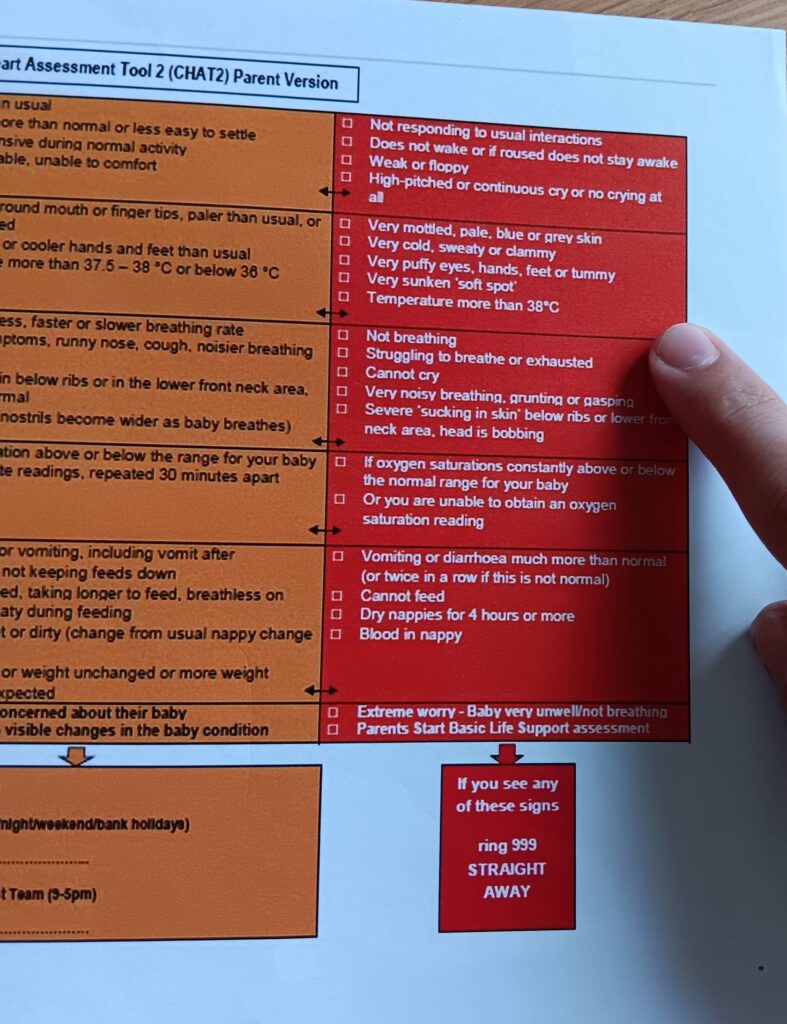
What is RED?
Before looking at the RED section it is important to remember that a baby’s breathing can change suddenly. This can happen to any baby.

It is an emergency if your baby:
- Has very noisy breathing. Is not able to cry. Shows signs of different movements in the chest, neck, and head.
- Is struggling to breathe. Is exhausted (extremely tired).
- Is not breathing. Ring 999
It is important to remember:
A baby with a complex heart condition could suddenly show changes described in the RED section.
The information in the RED section is shown below.
- If you decide your baby is showing a change that is described in the RED section then this is an emergency.
- You might decide there is a change in only one thing. This is still an emergency.
You are extremely worried.

For example:

If your baby’s feeding and nappies meets the description in the RED section, you must get emergency help.
It could be only one thing. For example, it is only ‘cannot feed’, or ‘blood in nappy’.
Ring 999
Watch the following videos.
Find yourself a quiet place. Find a time when you will not be disturbed. How about enjoying a favourite drink and snack while you watch?
The following 2 videos explain the 3 traffic light sections and the 6 assessment areas.
Video 1
The nurse is explaining the traffic light colours to a mother.
How do I use the 3 traffic light coloured sections?
Video 2
The nurse is explaining the 6 assessment areas to a mother.
How do I use the 6 assessment areas?
Is there anything else I need to know?
To help you use the CHAT properly you will also need to do some important things.
How to use the CHAT booklet
The CHAT booklet is where you will need to record (write down) important information about what you have found when you used the CHAT. This will be:
- What you have done.
- What you have assessed each day.
- The decision you have made.
Know your baby’s oxygen saturations
Your baby will need oxygen saturation levels measured regularly. You will need to record your baby’s oxygen saturation levels in the CHAT booklet.
Know your baby’s weight
Your baby will need to be weighed regularly. You will need to record your baby’s weight in the CHAT booklet.
Know who to contact if you need help
You will need to know who to contact if you need help.
Names and telephone numbers of the healthcare professionals will be written in the CHAT booklet.
You will find out more in Section 4. ‘What else do I need to help me assess my baby?’
What is GREEN?
The GREEN section describes what is ‘normal’ for your baby.
If you decide your baby is in this section, you can continue as normal and enjoy your baby.
You are happy.
IMPORTANT: After you have looked at each of the 6 areas in the GREEN section you will also need to look at the same areas in the AMBER section.
Compare the descriptions in GREEN with the descriptions in AMBER.
You must make sure there are no concerns.
What is in AMBER?
The AMBER section describes changes that are not normal for your baby.
If you decide your baby is showing something in the AMBER section then this is a concern.
You might decide there is a change in only one thing. This is still a concern.
You are concerned.
IMPORTANT: After you have looked at each of the 6 areas in the AMBER section you will also need to look at the same areas in the RED section
Compare the descriptions in AMBER with the descriptions in RED.
Make sure emergency care is not needed.
What is RED?
The RED section describes changes that are the most worrying.
If you decide your baby is showing a change that is described in the RED section then this is an emergency.
You might decide there is a change in only one thing. This is still an emergency.
You are extremely worried
Is there anything else I need to know?
To help you use the CHAT properly, you will also need to do some important things:
- How to use the CHAT booklet.
- Know your baby’s oxygen saturations.
- Know your baby’s weight.
- Know who to contact if you need help.