
2. What is the CHAT?
This section will give you an introduction to the Congenital Heart Assessment Tool (CHAT).
The following questions will be answered:
- What is the CHAT?
- How will the CHAT be used for my baby?
- What help will be given before my baby goes home?
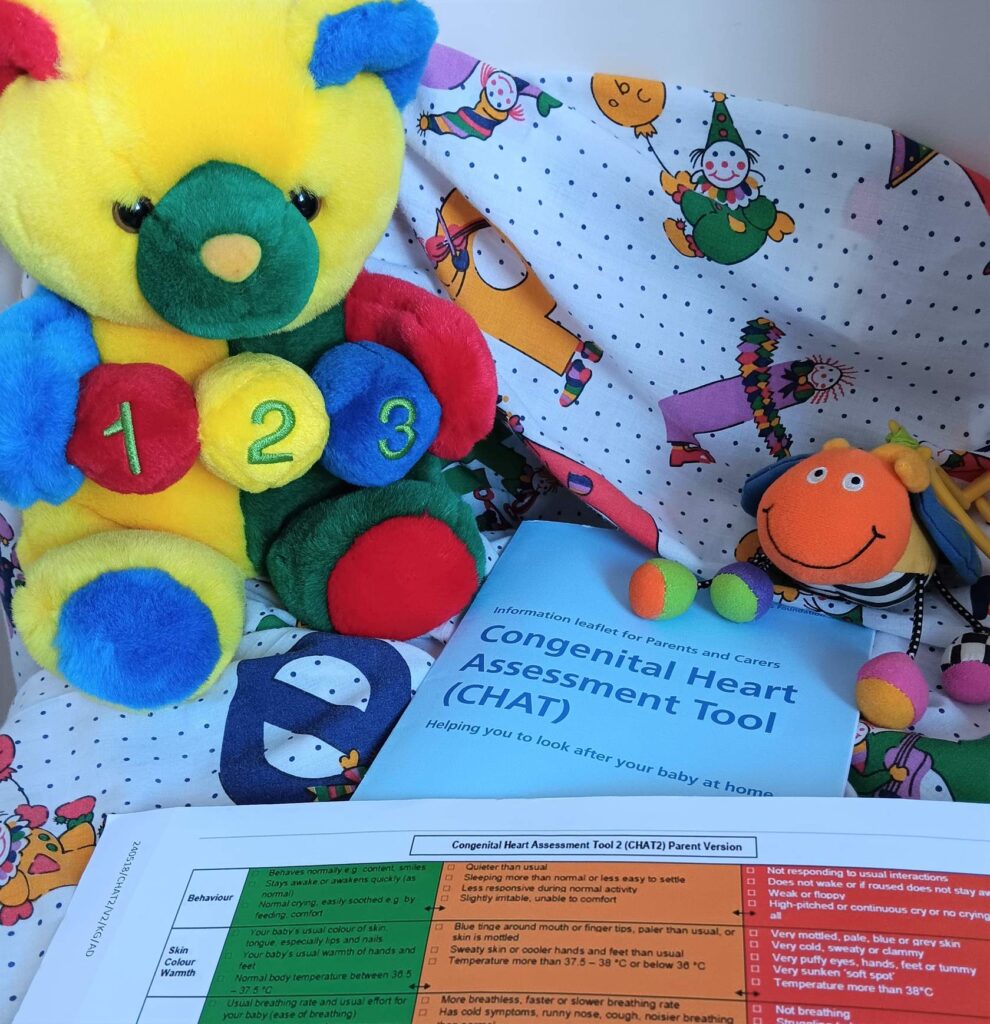
What is the CHAT?
The CHAT is an assessment tool to help you to care for your baby after you have left the hospital. It will help you to know what to look for and decide what to do. This means that you will be able to notice any changes to your baby’s health and well-being.
You can use the CHAT:
- At home.
- When you are not at home, such as when you are visiting family or friends.
When will I use the CHAT?
The CHAT will help your baby if you use it:
- Every day. It is important to do this at the beginning of the day. The CHAT will help you to know your baby is well; it will help you to notice if there is a worrying change.
- At any time. If you think you see changes during the day or night, use the CHAT again.
You will be given the CHAT before you go home.

I go through it every day and check my baby against it. I think it helps me to pinpoint what’s right and wrong. It definitely makes me more confident, if I didn’t have it as a backup I’d be panicking about everything and I’d be constantly ringing the hospital
Parent experience of assessing her baby every day.
How is CHAT designed?
The CHAT is divided into:
- 3 coloured sections.
- 6 assessment areas.
The 3 coloured parts.
Each section is coloured using traffic light colours:
GREEN
AMBER (orange)
RED
By using this system of colours you will be able to decide how well your baby is doing at home. It will help you decide what action to take if you see any worrying changes.
How will the colours help me to decide what to do?
Click on each of the 3 links below:
GREEN
This is when you decide everything is normal for your baby.
You are happy.
You can continue to enjoy caring for your baby as you would normally do.

AMBER (ORANGE)
This is when you decide your baby is not his or her ‘usual self’. Not behaving in the usual way.
You are concerned.
- It may be only one thing that has changed, but this is still a change from normal.
- You must discuss your concerns with a cardiac healthcare professional.
- You will need to make a telephone call to your baby’s cardiac healthcare professional.

RED
This is when you decide your baby needs emergency help.
You are extremely worried.
To get emergency help you will need to telephone for an ambulance.
Telephone 999 immediately.
Important: The ambulance will take your baby to the nearest hospital to your home.
This is to make sure your baby can quickly get hospital care. The professionals at this hospital will telephone your baby’s Cardiac Centre for advice.
Your baby will only be taken to the Cardiac Centre if this is in your local hospital.
You will find out more about the traffic light colours in:
Section 3: ‘How do I use the CHAT?’
What do I need to check in the 6 assessment areas?
To explain what is in each of the 6 areas, the information has been divided into 7 sections.
Click on each of the 7 sections below:
You will be able to assess:
- 1. Behaviour
- 2. Skin Colour and Warmth
- 3. Breathing
- 4. Oxygen Saturations
- 5. Feeding
- 6. Nappies
- 7. Parent Response
Your baby is an individual.
Your baby’s behaviour will be affected by his/her personality. It will also be affected by how well he/she is feeling.
It is important to decide on what is ‘normal’ for your baby.
Many things can make up an individual baby’s ‘normal’ behaviour. It can include such things as:
- How well a baby is feeding. This includes the amount of much milk is taken at each feed and how easy it is for a baby to feed.
- How easy is it for a baby to breath when feeding, resting and when active.
- The energy a baby needs to use to be active. For example, kicking and smiling.
- How a baby reacts to parents and family. For example, do they smile when talked or sang to? Do they enjoy a cuddle?
- How easy it is to make a baby content and happy. What makes a baby comfortable or uncomfortable?
- How easy it is for a baby to settled to sleep and wake up.
You will know what makes your baby happy or upset.

Assessing skin colour and warmth is important. It tells us:
- How well the blood is circulating (flowing) around your baby’s body.
- How well oxygen is being carried around your baby’s body.
- How well your baby is being kept warm by the circulating blood.

This is important because babies need to be able to breathe in oxygen from the air.
Your baby needs to be able to breathe without having to try harder than is necessary.
You will get to know how your baby normally breathes. Healthcare professionals will help you to know what is normal for your baby.
A sign of difficulty with breathing may be because your baby is becoming unwell.
It could be a mild illness or it could be something more serious.
It will be good for you to:
- Tell healthcare professionals about any changes to your baby’s breathing so they can understand what you are seeing.
- Get advice and be told what you need to do.
- Know when you need to get emergency help.

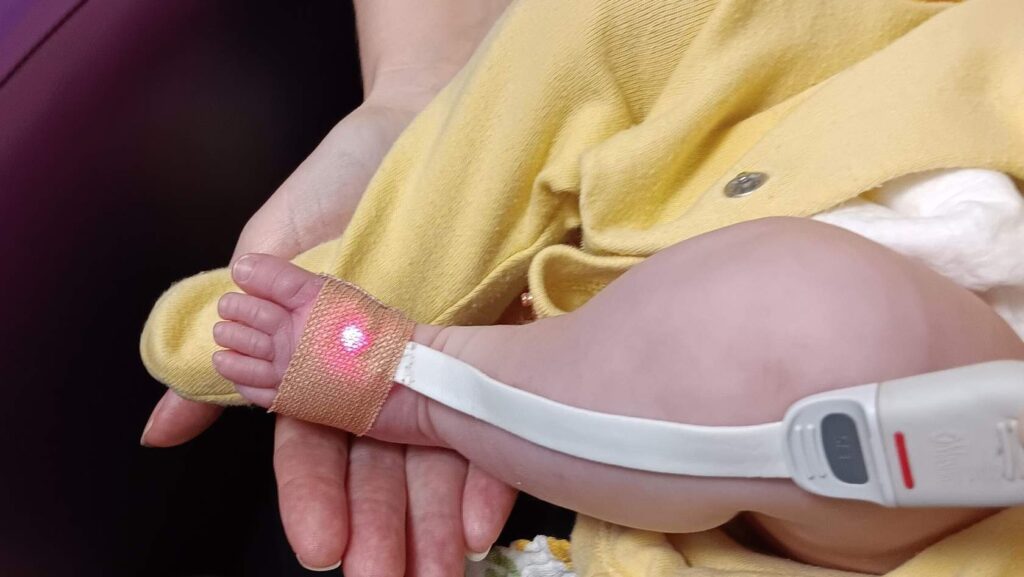
As you know, your baby’s oxygen saturation level in the blood was checked very closely while in hospital.
This was important because it continually showed if the oxygen level was good or if there was a problem. It helped to show any difficulties with:
- How the heart was working.
- How blood was circulating to the lungs.
- How the blood was circulating around the body.
It also helped to decide if there was any illness developing.
It is important to assess feeding. You will need to be able to notice any changes to how your baby feeds and how much your baby feeds.
It will be good to notice if your baby is:
- Feeding easily. Or struggling to feed.
- Taking normal amounts at each feed. Or taking less.
- Feeding regularly. Or not feeding regularly,
- Vomiting? Is this after feeds? Is this after medication?
It is also important to assess weight gain and weight loss. This helps you to know:
- How well your baby is growing and developing.
- If there is a problem with how the heart is working.
You will be told what is good weight gain for your baby.
Assessing feeding also includes assessing nappies. This is explained in the next section.

It is also important to assess your baby’s nappies and notice any changes.
You need to know:
- The amount of wet and dirty nappies your baby normally has each day.
- If there is a change. Are there fewer wet nappies than normal? Are the nappies drier than normal? Is there a change to stools (poo). For example, diarrhoea (loose stools), constipation (hard stools)?

Parent response is very important.
You will know your baby well. You will know if there are changes that are not normal for your baby. This will be how you are naturally feeling.
It is important for you to decide if you are:
- Happy with your baby. You feel good. All is well.
- Concerned about your baby. You feel your baby is ‘not right’ even though you are not seeing a change. This is often called a ‘gut feeling’, ‘a hunch’ or ‘intuition’. This means you are feeling uncomfortable about something even though things might look fine.
- Extremely worried. You are absolutely not feeling good.
Trust how you feel.
Healthcare professionals take your response very seriously.
They respect what you need to tell them – you are the best person to act for your baby.

By checking these 6 assessment areas you will be able to decide whether your baby is:
- Doing well.
- Showing signs of difficulty.
- Extremely unwell.
This will help you to decide if there are any actions you need to take.
You will find out more about the 6 assessment areas in
Section 3: ‘How do I use the CHAT?’

How will the CHAT be used for my baby?
All babies are treated as individuals.
There are many types of complex heart problems and so babies will be affected in different ways. It is important that you concentrate on how your baby is affected.
How the CHAT will be used will be individual to your baby. When you use the CHAT you will need to understand:
- How to use it for your baby.
- The level of concern that applies to your baby.
Your baby’s cardiac healthcare professionals will tell you what will be ‘normal’ for your baby. This will include what is normal for:
- Breathing.
- Oxygen saturation level.
- Colour and warmth of skin.
- Nutrition – the type of milk and the amount for each feed. This will include the amount of wet and dirty nappies each day.
- Weight, growth and development.
The oxygen saturation level is very important. Your baby’s Cardiac Consultant will decide the level that is right for your baby. You may hear professionals talk about ‘individual parameters’. This means deciding on the:
- Highest reading that is safe for your baby.
- Lowest reading that is safe for your baby.

What help will be given before my baby goes home?
The nurses on your baby’s ward and the Cardiac Specialist Nurses will talk to you about taking your baby home. This should happen at least 5 days before you go home.
The CHAT is just one of the things you will need to know about before going home.
You will be able to discuss the CHAT and ask questions. It is important to understand:
- What has been decided as normal for your baby. And why this has been decided.
- How to assess your baby daily and at any other times if you feel there is a change to any of the 6 areas in the CHAT.
- How to keep a record of what you have seen, what you have decided and anything you have done.
- What to do when you decide your baby is in section AMBER (concerned) or RED (extremely worried).
You will find out more in
Section 3: ‘How do I use the CHAT?’
Section 4. ‘What else do I need to help me assess my baby?
Watch the following video.
This video shows a Cardiac Nurse Specialist meeting a mother. This is the beginning of introducing the CHAT.
Summary of information
What is the CHAT?
The CHAT is an assessment tool to help you to care for your baby after you have left the hospital. It will help you to know what to look for and decide what to do. This means that you will be able to notice any changes to your baby’s health and well-being.
- You will need to assess your baby at least once every day.
- Do this at the beginning of each day.
- You can use it at home and when you are not at home, such as visiting family.
It is divided into:
3 coloured sections.
6 assessment areas.
How will the CHAT be used for my baby?
Babies are treated as individuals.
It is important that you concentrate on your baby. This includes:
- Understanding the level of concern that applies to your baby.
- Understanding what is ‘normal’ for your baby.
Your baby’s cardiac healthcare professionals will tell you what will be ‘normal’ for your baby.
What help will be given before my baby goes home?
The nurses on your baby’s ward and the Cardiac Specialist Nurses will talk to you about taking your baby home. This should happen at least 5 days before you go home.
You will be able to discuss the CHAT and ask questions. It is important to understand:
What to do when you decide you need to telephone a healthcare professional.
How to use the CHAT for your baby.
How to assess your baby daily and at any other times.
How to keep a record of what you have seen, what you have decided and anything you have done.