
6. Do I understand my baby’s heart condition?
From the moment you were told that your baby had a complex heart problem you have probably:
- Looked at lots of information.
- Had many questions to ask (and still have many more questions to ask).
- Supported your family and friends to help them understand your baby’s heart problem.
There will always be important information for you to understand. This will be given to you by your baby’s cardiac healthcare professionals.
However, you may want to look online. Your family might look online and tell you about the information they have found. But with so many websites, you might decide there is too much information to understand. You might sometimes feel a bit confused if things are explained differently.
Before you start to understand more about your baby’s heart condition it would be helpful for you to understand how the normal heart works. Understanding how the heart works will help you to understand the surgical and medical care your baby needs.
This section will give you information on how the normal heart works and show you some of the main trusted websites where you can find the information and support you need.
This section will answer the following:
- How can I understand how a normal heart works?
- How can I find out more about my baby’s heart condition? Which websites should I use first?

How can I understand how a normal heart works?
How does blood flow through a normal heart?
The body needs energy. This is provided by blood which carries oxygen, nutrients (food) and water to the organs in the body.
The heart acts as a pump that forces blood around the body. With every beat of the heart, blood is moving into and out of the heart. There are two separate circulations (movement of blood):
1.
Pulmonary Circulation. Blood flows from the right side of the heart to the lungs. This blood has a low level of oxygen.
Blood flows from the lungs back to the heart. The lungs have taken out carbon dioxide and put oxygen into the blood.
2.
Systemic Circulation. Blood flows from the left side of the heart to the body systems. This blood has a high level of oxygen.
The heart has:
- Four chambers to collect and pump blood through the heart.
- Four valves to make sure the blood flows in one direction through the heart.
The Heart
This is a ‘click on’ diagram of the heart. Click on on the labels to find out how blood flows through the heart.
When you look at this diagram it is important to remember that you are looking at a heart of someone stood in front of you. So the person’s right side is on your left : the person’s left side is on your right.
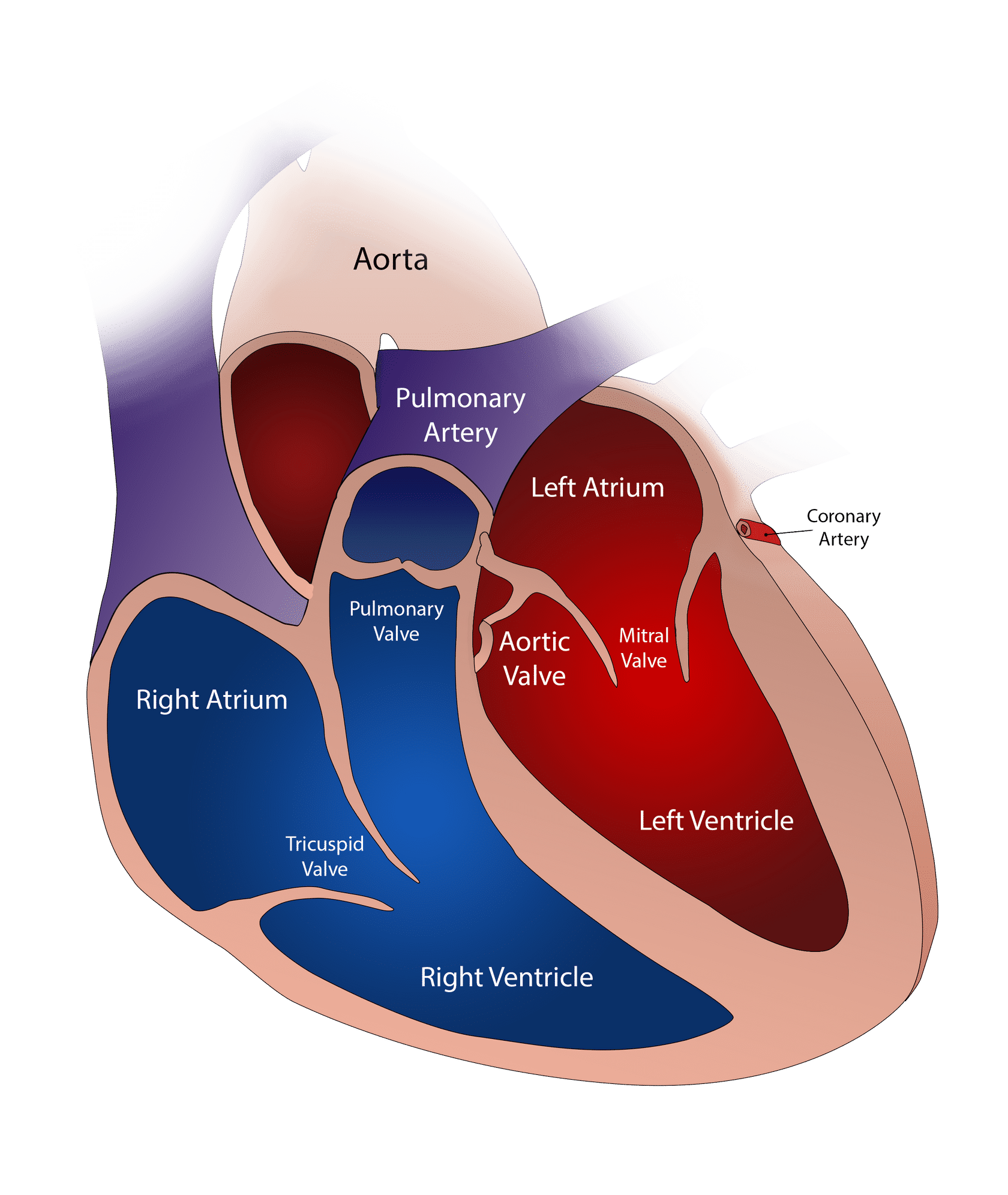
Blood from the body comes back to the heart.
Two Veins bring blood back to the right side of the heart so it can go to the lungs. This blood comes from the organs of the body. The organs of the body have:
- Taken oxygen from the blood.
- Put the carbon dioxide into the blood.
The blood needs to get more oxygen and get rid of the carbon dioxide.
The blood comes from the top and bottom part of the body (this picture shows just the vein coming from the top).
Blood enters the right side of the heart.
- It goes into the collecting chamber. This is called the Right Atrium.
- This blood has a bluish tinge (blue blood) because it is low in oxygen.
- You may hear people use the phrase deoxygenated blood.
Blood passes through a valve and down the right side of the heart
The first valve is called the Tricuspid Valve.
- Blood from the Rigth Atrium passes through this valve.
- This valve makes sure the blood flows in one direction – from the Right Atrium to the next chamber of the heart.
Blood enters the next chamber of the heart.
This chamber is called the Right Ventricle.
The Right Ventricle is known as a pumping chamber. This is because it will pump blood to the lungs.
Blood needs to get to the lungs.
The second valve is called the Pulmonary Valve.
- Blood passes up through this valve.
- This valve makes sure blood flows in one direction from the pumping chamber (the Right Ventricle), into the large blood vessel.
- This large blood vessel is called the Pulmonary Artery.
This artery them becomes two arteries:
- The Right Pulmonary Artery. This takes bluish blood to the right lung.
- The Left Pulmonary Artery. This takes bluish blood to the left lung.
Blood enters the left side of the heart.
Blood enters this collecting chamber, called the Left Atrium.
it has come back from the lungs. In the lungs:
- Carbon dioxide has been taken away from the blood.
- Oxygen has been put into the blood. It is now red coloured. You may here people call it oxygenated blood.
The blood needs to get to the organs of the body.
Blood passes through a valve on the left side of the heart.
The third valve is called the Mitral Valve.
- Blood from the Left Atrium passes down through this valve.
- This valve makes sure the blood flows in one direction – from the Left Atrium to the next chamber of the heart.
Blood enters the next chamber of the heart.
This chamber os called the Left Ventricle.
- The Left Ventricle is know as a pumping chamber.
- This is becuase it will pump blood out of the left side of the heart to the body organs.
Blood needs to get out of the heart.
The fourth valve is called the Aortic Valve.
- Blood passes up through this valve.
- This valve makes sure blood flows in one direction from the pumping chamber (the Left Ventricle) into the large blood vessel.
- This vessel takes blood away from the left side of the heart.
Blood flows out of the heart and goes to the organs of the body.
- The blood flows out from the left side of the heart.
- It passes through a large artery called the Aorta.
- Blood then flows through more arteries to take oxygen around the body.
More information.
You might like to understand more.
The following information includes a short video which explains how blood flows through the normal heart.
Click on link the weblink below:

Summary of information.
Click on the card below:
How can I understand how a normal heart works?
The body needs energy. This is provided by blood which carries oxygen, nutrients (food) and water to the organs in the body.
The heart acts as a pump that forces blood around the body. With every beat of the heart, blood is moving into and out of the heart. There are two separate circulations (movement of blood):
1. Pulmonary Circulation. Blood flows from the right side of the heart to the lungs. This blood has a low level of oxygen.
Blood flows from the lungs back to the heart. The lungs have taken out carbon dioxide and put oxygen into the blood.
2. Systemic Circulation. Blood flows from the left side of the heart to the body systems. This blood has a high level of oxygen.
The heart has:
- Four chambers to collect and pump blood through the heart.
- Four valves to make sure the blood flows in one direction through the heart.

How can I find out more about my baby’s heart condition?
Which websites should I use first?
The best places to look.
It is important for all parents to understand information given to them about their babies heart condition. For some parents, their baby might have a heart condition which has some differences to the conditions explained on websites. This makes the information given by the cardiac healthcare professional especially important.
You may have looked at many websites from around the world. Many of them are very good. But it is important to remember that the National Health Service of the United Kingdom (UK) provides your baby’s care. You will need to understand the surgery and treatment given in the UK.
The best UK websites have been developed by UK professionals, heart charities and parents of babies who have had their care here.
Often people like to have information explained and presented in different ways. This section includes a few websites that are recommended by UK cardiac healthcare professionals.
Little Hearts Matter (LHM)
Little Hearts Matter (LHM) is a charity that was set up in 1994. Parents of children who had Hypoplastic Left Heart Syndrome were needing extra advice and support. They needed to be able to trust this extra information. Parents raised money to support parents, children and young people affected by a diagnosis of a single ventricle heart (this means that one of the collecting two chambers of the heart is not able to work correctly). They also helped to develop a website. In 2004, LHM increased the number of families it could help when it included other heart conditions with a diagnosis of a single ventricle heart.
This charity has always been supported by cardiac healthcare professionals. Professionals from all of the cardiac centres of the UK have helped to develop and support the website.
Little Hearts Matter has an excellent website. It contains lots of very helpful information. You may have already visited this website. If you have not, then this may be a good time for you to start to discover how useful it can be for you, your baby and your family.
To understand your child’s heart problem you might like to look at the links below from the LHM website. Included in these links are short videos showing how blood flows through a normal heart and how blood flows through the heart of a baby with a complex heart condition.
Select your baby’s heart condition from the list below.
Hypoplastic Left Heart Syndrome
Tricuspid Atresia
Pulmonary Atresia with intact ventricular septum
Double Inlet Left Ventricle
Double Outlet Right Ventricle
Hypoplastic Right Heart
Ebstein’s Anomaly
One and a half ventricles
Complex Atrial Ventricular Septal Defect
Tiny Tickers
Another useful website is Tiny Tickers. This was founded in 1999. It is a smaller charity than Little Hearts Matter but aims to provide similar support and advice. Its website includes heart conditions other than those with a single ventricle.
The link below will take you to the webpage ‘What is Congenital Heart Disease?‘ You will find a list of heart conditions. In each of the heart conditions there are also personal stories. Most of these stories are told by parents.
You may wish to read the first item in the list called ‘Single Ventricle Defects‘. Then move on to read about your child’s single ventricle heart condition.
Click on weblink below:

The British Heart Foundation (BHF).
The British Heart Foundation (BHF) provides support and information about conditions that affect adults and children. There is a webpage section called Children and Young people.
This contains a link called ‘Heart conditions in young people‘. Here you will find information on children’s heart conditions. Amongst them are:
- Hypoplastic Left Heart Syndrome.
- Tricuspid Atresia.
- Pulmonary Atresia with Intact Ventricular Septum.
Select from the list below.
The following contains useful information for a child or young person to read, but you may also find it helpful.
Understanding your congenital heart condition
‘Congenital heart disease means a heart condition or defect that develops in the womb, before a baby is born.
There are many different types of congenital heart disease. For example, a baby’s heart valves may not be properly formed or there may be holes between the chambers of their heart.’
Summary of information.
Click on the card below:
How can I find out more about my baby’s heart condition?
Which websites should I use first?
It is important for all parents to understand information given to them about their babies heart condition. For some parents, their baby might have a heart condition which has some differences to the conditions explained on websites. This makes the information given by the cardiac healthcare professional especially important.
The best UK websites have been developed by UK professionals, heart charities and parents of babies who have had their care here. The following websites are recommended:
- Little Hearts Matter (LHM)
- Tiny Tickers
- The British Heart Foundation (BHF)
Here you will find useful information, advice and support.
You have now finished Sections 1 – 6.
You have finished the learning package.
Now that you have learnt about the CHAT you will have the opportunity to discuss it with a cardiac nurse or a Cardiac Nurse Specialist.
Before you do this:
- Think about what you have understood. You may want to discuss things further.
- Make notes on anything you have not understood.
- What questions might you want to ask the cardiac healthcare professionals?
It is important that you feel confident to use this assessment tool.
If you wish, you can continue on to Sections 7 and 8.
Section 7: How do cardiac professionals know about the CHAT?
Section8: How can I give an opinion about this learning package?