
5. What will happen if I need to make a telephone call?
You will need to make a telephone call if you decide you are:
Concerned
You decide your baby is in the AMBER section.
You will need to telephone a cardiac health care professional.
Extremely worried
Your decide your baby is in the RED section.
You will need to telephone the emergency services immediately.
Telephone 999 and ask for an ambulance.
This section will answer the following questions:
- What will happen when I telephone a cardiac healthcare professional?
- What will happen when I telephone 999?
- What can I do while I wait for emergency help?
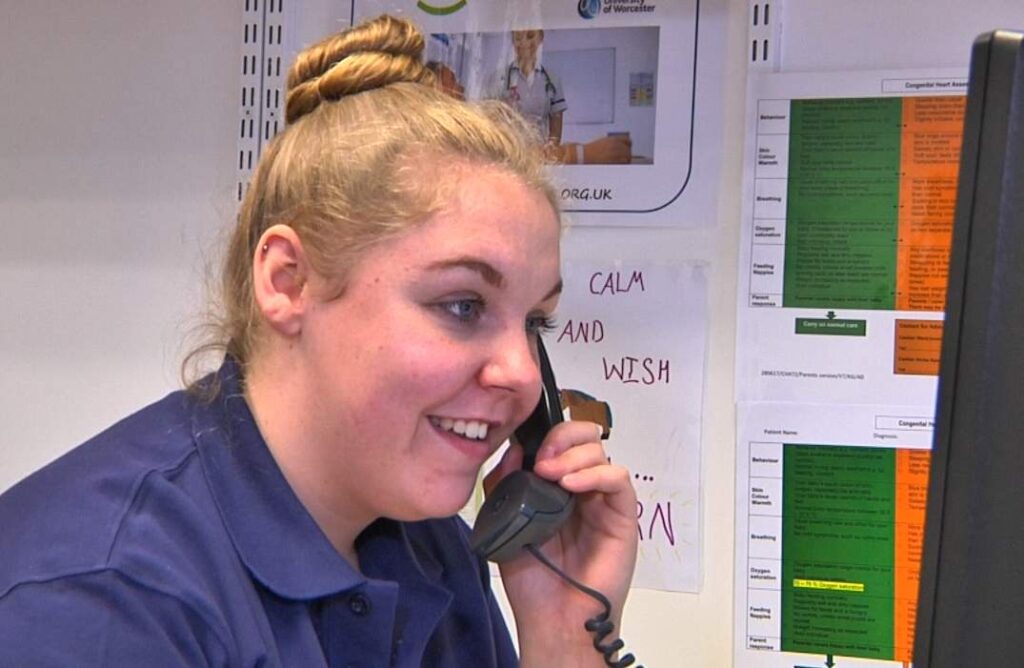
What will happen when I telephone a cardiac healthcare professional?
You may be feeling very nervous about making a telephone call when you are concerned about your baby. This is a natural feeling.
But remember, you will be talking to a healthcare professional at your baby’s Cardiac Centre. This person will be a member of the cardiac team and will have information about the history of your baby’s care.
The person you are talking to will help you to explain what is happening to your baby.
You may find you are talking to someone who knows you and your baby well.
What will the cardiac healthcare professional do?
The person you are speaking to will also be using the CHAT.
The CHAT will help both of you to have a clear conversation. The member of the cardiac team will:
- Listen to you.
- Respect what you are saying.
- Ask you some questions.
- Decide what needs to be done.
- Give you instructions about what you need to do for your baby.
The instructions might be:
- Something quite simple and this helps your baby to return to the GREEN section.
- Information about taking your baby to the children’s ward at your local hospital or to the Cardiac Centre. The decision on where to take your baby will depend on the concern you are explaining.
What do I need to do?
There are some simple things you can do.
Click on the button 1 – 8 below:

1. Stay as calm as you can.
The cardiac healthcare professional will help you to stay calm.
You will be supported when you are having a conversation to share your concerns.
2. Keep your baby close to you.
Continue to look after your baby.
if you see more changes, tell the cardiac healthcare professional straight away.
For example, your baby is awake but suddenly looks sleepy.
3. Speak clearly.
- You may want to tell the healthcare professional lots of things because you are concerned.
- But try to slow down your speach.
- This will help you to explain everything clearly.
It will help the healthcare professional to:
- Understand what you are telling them.
- Decide what needs to be done.
4. Say who you are.
The cardiac healthcare professional needs to know who is telephoning.
Say:
- you are the parent.
- your name.
- the name of your baby.
- you are concerned.
If you are alone with your baby, tell this person.
If a member of your family or a friend is looking after your baby and needs to make a telephone call, they will need to say that they are not your baby’s parent.They must say who they are. For example, it could be your baby’s grandparent.
5. Explain you have assessed your baby, using the CHAT.
Say you have decided yor baby is in the AMBER section.
Explain what you are concerned about. it maybe:
- one thing.
- more than one things.
6. Have the CHAT in front of you.
This will help you explain what is happening to your baby.
The cardiac healthcare professional will also use the CHAT during the conversation with you.
This will help you both communicate clearly.
It will help you to get the correct advice about what to do.
7. You will need to answer questions.
When you are explaining your concerns, you will also be asked questions. The cardiac healthcare professional will use the information on the CHAT to ask these questions.
The person who answers the telephone might be someone who cared for your baby after surgery and knows both you and your baby well.
But you may still need to answer questions while they get information from your baby’s health record.
Questions might include:
- What is your baby’s heart condition?
- When did your baby have surgery?
- When did your baby leave hospital?
- How your baby has been since leaving the hospital?
- When was your baby last seen in the heart clinic?
- What medicine are you giving to your baby?
It would be good for you to know this information.
8. If you see your baby suddently become more unwell.
If you notice more or sudden changes to your baby while you are talking, you must tell the cardiac healthcare professional.
- The changes might cause your baby to stop breathing.
- You might see that your baby suddenly stops breathing.
You will be given instructions on what to do.
One parent described how it felt like to be able to telephone the Cardiac Centre:

“… it does give you a lot of reassurance, obviously being able to phone the ward when it is in an amber state, having them reassure you and tell you what to do, it’s very helpful. Because obviously if that’s the case like an amber alert I would normally phone 111 the NHS service and then you’d have to explain what the condition is and not having to go through all of that, it again alleviates some of the pressure“
Parent experience of phoning for advice.
Watch the following video.
Find yourself a quiet place. Find a time when you will not be disturbed. How about enjoying a favourite drink and a snack while you watch?
This video is an example of a telephone call. It shows what could be discussed. The video is about 10 minutes long.
Your telephone call will be unique to you and your baby. How long you need to talk to the cardiac healthcare professional will depend on what you need to discuss.
In this video the mother is telephoning because she is concerned about her baby’s feeding. The CHAT helps:
- The nurse to ask the right questions.
- The mother to explain her concerns about her baby.
What happens during a telephone call to the Cardiac Centre?

What will happen when I telephone 999?
Making a 999 telephone call can feel very frightening. You will be extremely worried about your baby. This is a natural feeling for all parents.
You will be speaking to an emergency call handler. This is the person who will answer your call.
The emergency call handler will listen to the information you give and then arrange for urgent medical help to be sent to you and your baby. This will be an ambulance and paramedic team (healthcare professionals who are qualified to deliver emergency care).
What will the emergency call handler do?
This person will:
- Ask questions to make sure they understand what is happening to your baby.
- Stay talking to you until the paramedic team arrives.
- Guide you and offer advice while you are waiting and caring for your baby.
You will not be alone.
What do I need to do?
When you telephone 999 put your phone on loud speaker.
Keep your phone on loud speak. This will make it easier for you to:
- Talk to the call handler.
- Hear what the call handler is saying to you.
Have the CHAT in front of you. This will help you to explain what is happening to your baby.
The call handler will need to know if your baby has stopped breathing. You will be asked “has the patient stopped breathing?”
You must tell the call handler if your baby:
- Has stopped breathing.
- Is struggling to breathe.
Also:
- Tell the call handler your baby has had surgery for a complex heart problem.
- If you are alone with your baby, tell the call handler.
It will be natural to feel frightened and upset, but try to:
- Stay as calm as you can. The emergency call handler will help you to stay calm.
- Speak clearly.
- Let the call handler help you to explain what is happening to your baby.
Remember, using the CHAT will:
- Help you to explain what is happening to your baby.
- Give you the knowledge and confidence to make sure the call handler understands what is happening to your baby.
Remember you are the expert person at home with your baby.

What can I do while I wait for emergency help?
Before you leave the hospital, you will be offered training on how to perform basic life support for an infant. You will hear people calling it BLS (Basic Life Support).
If your baby stops breathing you will be able to give valuable help.
The call handler will help and support you.
You will not be alone.
This 2 minute video shows a person who is alone and needs to give BLS to a baby. It gives simple instructions on how to perform BLS on a baby under the age of 1 year. You may wish to watch before your cardiac nurse teaches you BLS.
Please click on the weblink below.
Everything you learn in your BLS training has been decided by the Resuscitation Council United Kingdom (UK). This means you will be given the correct instructions.
Please remember that:
- The training you will be given is for you to give BLS to your baby. It is will not give you a qualification in resuscitating babies.
- You would be giving basic life support. You will not have any resuscitation equipment or professionals around you until the paramedic team arrive.
Your will be giving BLS to:
- A. Keep your baby’s Airway open.
- B. Help with your baby to Breathe.
- C. Keep your baby’s blood Circulating (flowing).
The guidelines of the Resuscitation Council of the UK covers all of the actions needed for resuscitation of adults, children and infants.
The link below covers the care of children and infants. There is a lot to read and understand. But if you do wish to know more, please see the link below.
You do not need to know all of this.
You will be taught all you need to know for giving BLS to your baby.
If you have any questions, please talk to a cardiac healthcare professional.
Please click on the weblink below.

Summary of information.
Click on the cards below:
What will happen when I telephone a cardiac healthcare professional?
The person you are speaking to will also be using the CHAT.
The CHAT will help both of you to have a clear conversation. The member of the cardiac team will:
- Listen to you.
- Respect what you are saying.
- Ask you some questions.
- Decide what needs to be done.
- Give you instructions about what you need to do for your baby.
What will happen when I telephone 999?
The emergency call handler will:
- Ask questions to make sure they understand what is happening to your baby.
- Stay talking to you until the paramedic team arrives.
- Guide you and offer advice while you are waiting and caring for your baby.
You will not be alone.
Remember, using the CHAT will:
- Help you to explain what is happening to your baby.
- Give you the knowledge and confidence to make sure the call handler understands what is happening to your baby.
Remember you are the expert person at home with your baby.
What can I do while I wait for emergency help?
Before you leave the hospital, you will be offered training on how to perform basic life support for an infant.
If your baby stops breathing you will be able to give valuable help, while you wait for the paramedic team to arrive.
The call handler will help and support you.
You will not be alone.